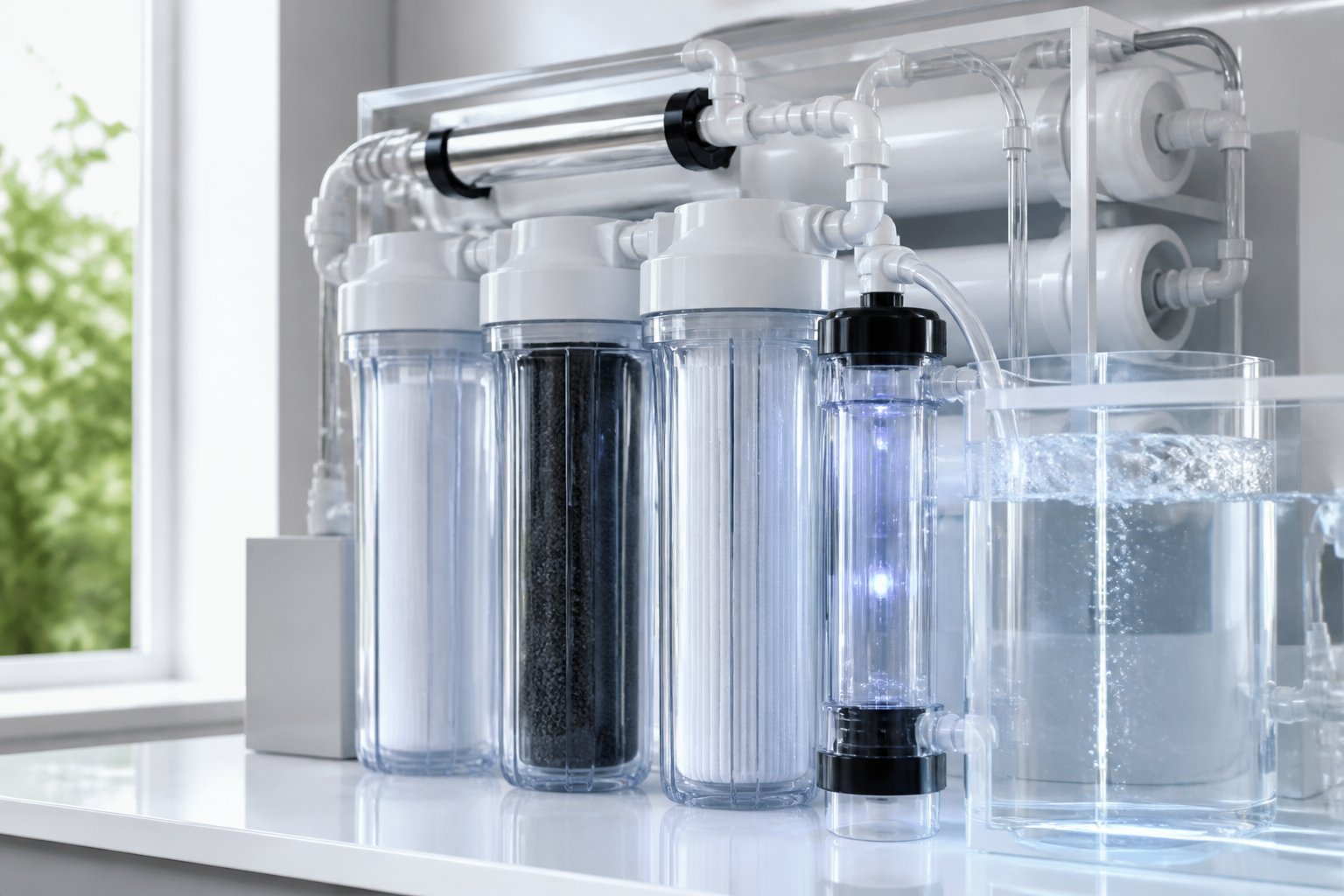
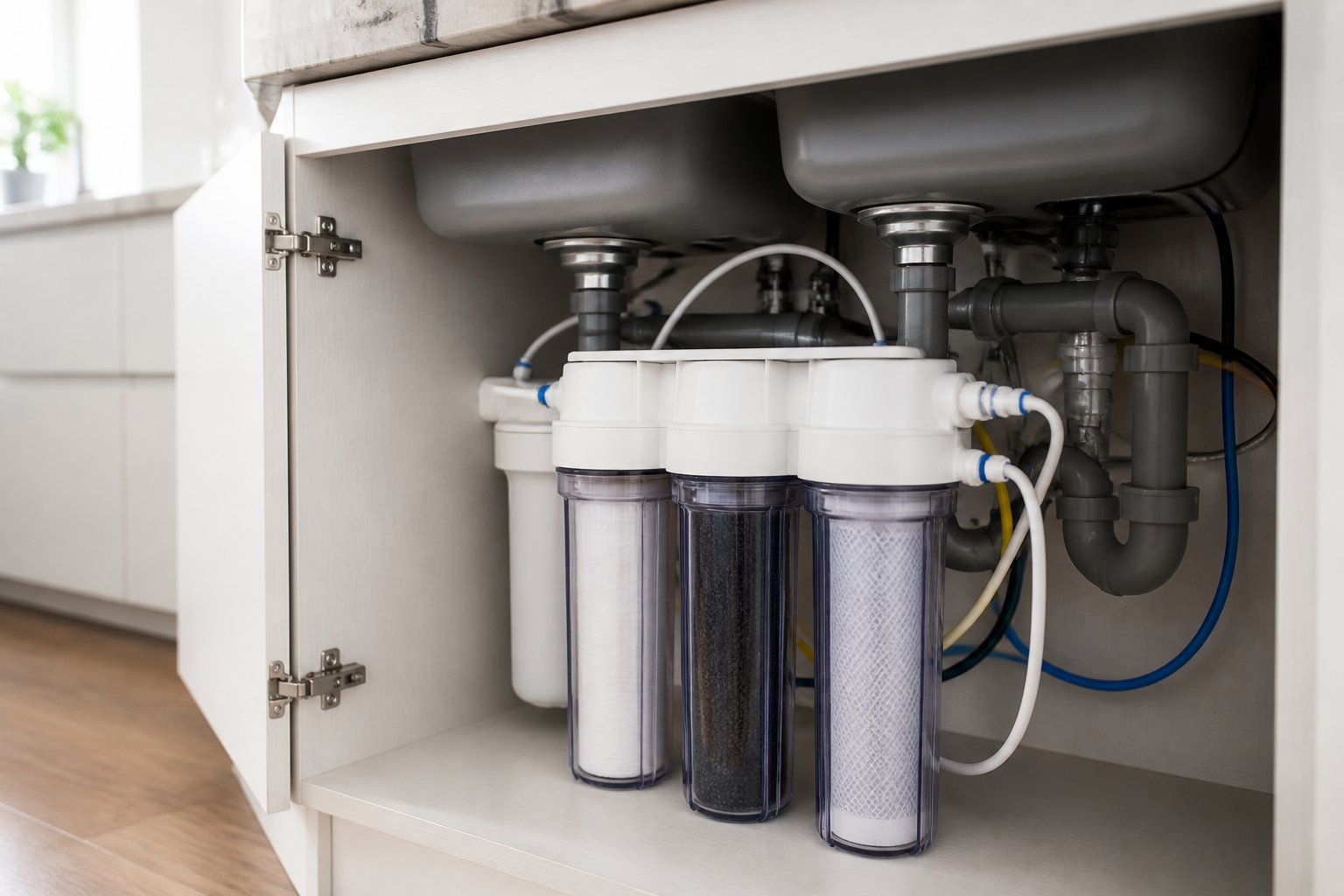
Key Components and Filtration Stages
You get cleaner water by combining filters that target different contaminants and problems. Each stage has a clear job: trap particles, remove chemicals, neutralize metals or microbes, and polish water for drinking or appliances.
Sediment Pre-Filters and Micron Ratings
Sediment pre-filters protect downstream media and appliances by removing sand, rust, and dirt. These cartridges sit in a filter housing at the main line and are usually the first stage in a cartridge system. Common ratings include 5-micron for fine particles and 20–50 micron for coarser debris. Choose a 5-micron sediment filter if you want to reduce visible cloudiness and protect a reverse osmosis membrane.
Sediment cartridges come as pleated or depth-wound styles. Pleated cartridges last longer and handle higher flow, while spun or depth-wound types are cheaper. Replace cartridges on schedule or when pressure drops to avoid clogging other media.
Activated Carbon and Carbon Block Media
Activated carbon removes chlorine, many volatile organic compounds (VOCs), and tastes or odors. You’ll see two main forms: granular activated carbon (GAC) and carbon block filters. GAC is good for high flow and initial chemical adsorption. Carbon block delivers higher contact time and better particulate filtration because it’s denser and often rated by micron.
Carbon blocks fit into standard housings and act as primary chemical polishers for whole house systems. They work well as a post-filter after sediment stages. Replace carbon cartridges based on contaminant load, not just time; heavy chlorine or organics shorten service life.
KDF, Catalytic Carbon, and Advanced Filtration
KDF media and catalytic carbon tackle chlorine, chloramines, and some heavy metals. KDF (a copper-zinc alloy) uses redox reactions to reduce chlorine and convert soluble metals like lead and iron into removable forms. Catalytic carbon is specially treated to speed up chloramine removal, something ordinary activated carbon struggles with.
You’ll often see KDF used ahead of carbon blocks to protect them and extend life. Advanced combinations—KDF + carbon block or multi-media beds—help control scale, sulfides, and manganese. These setups use multiple filter cartridges or larger tank media, so check compatibility with your filter housing and flow needs.
UV, Reverse Osmosis, and Water Softeners
UV purifiers inactivate bacteria and viruses without chemicals. You install a UV chamber after sediment and carbon stages so light reaches clear water. UV doesn’t remove particles or chemicals, so it’s a final microbial barrier rather than a full treatment.
Reverse osmosis (RO) systems sit at point-of-use or as a whole-house unit in larger setups. RO forces water through a membrane to remove dissolved solids, heavy metals, and many contaminants. RO needs pre-filtration (sediment and carbon) and a post-filter for taste.
Water softeners come as salt-based or salt-free options. Salt-based softeners use ion exchange to remove hardness minerals and require regeneration cycles and brine. Salt-free systems use template-assisted crystallization or specialized media to reduce scale without salt. You can combine softeners with whole-house filters, but plan placement: softeners after filtration can improve resin life, while RO usually needs untreated feed or specific pre-filters.
Contaminants Removed and Water Quality Improvement

This section explains which contaminants whole-house systems typically remove and how that changes your water’s taste, smell, and safety. Expect specifics on chemical removal, particulate protection, and treatment limits so you can match a system to your plumbing and water source.
Chlorine, Lead, and Heavy Metals
Chlorine and chloramine are common in municipal water. Activated carbon and KDF media remove most free chlorine and reduce chloramine when sized correctly. This improves taste and removes the “bleach” odor at every tap.
Lead and other heavy metals like mercury and copper require targeted media. Granular activated carbon alone reduces some lead, but catalytic carbon, KDF, or special ion-exchange cartridges give stronger lead and mercury removal. Confirm NSF/ANSI certifications (e.g., 53 for lead) when buying filters to ensure verified performance.
Test your water for specific metal concentrations first. Cartridge flow rate, contact time, and filter bed size affect removal. If you have high levels, use a multi-stage system that lists heavy-metal reduction and matches your household flow needs.
Pesticides, Herbicides, and VOC Reduction
Volatile organic compounds (VOCs), industrial solvents, pesticides, and herbicides often enter water from runoff or old industrial sites. Large beds of activated carbon are the most effective common treatment for these chemicals.
Look for systems that specify removal of specific VOCs or pesticides and list lab test results. Carbon works best when contact time is long and water is not too turbid. If your water has many dissolved organics, consider a multi-stage tank with pre-sediment filtration to protect the carbon stage.
If you need point-of-entry protection for all faucets, choose a whole-house tank system with high-capacity carbon. For under-sink or drinking-water use only, a smaller reverse-osmosis or carbon block unit can give higher removal for specific VOCs and industrial solvents.
Special Contaminants: Arsenic, Fluoride, Nitrate, PFAS
Arsenic, fluoride, nitrate, and PFAS are chemically different, so each needs a specific treatment method. Arsenic is commonly removed by specialized media (iron-based adsorption) or strong anion exchange. Check the media life and replacement schedule.
Fluoride and nitrate require ion-exchange or reverse osmosis (RO) for reliable reduction. RO systems consistently lower fluoride and nitrate but usually serve a single tap unless you plumb an RO for whole-house, which is rare and costly.
PFAS (“forever chemicals”) respond well to large, high-quality activated carbon beds and to RO. Systems claiming PFAS removal should publish test data. Confirm capacity, because PFAS can saturate carbon over time and need media replacement on a predictable schedule.
Addressing Sediment, Hard Water, and Hydrogen Sulfide
Sediment, rust, and sand are removed by 1–50 micron sediment filters or media tanks rated by micron size. Install a pre-filter before carbon or softening equipment to extend media life and maintain flow.
Hard water (calcium, magnesium) needs a true water softener using ion exchange to replace hardness with sodium or potassium. Salt-free conditioners reduce scale buildup but do not remove hardness minerals; they only change how minerals behave. Choose a softener sized to your household grain-per-gallon (gpg) load and regeneration frequency.
Hydrogen sulfide (rotten-egg odor) can be oxidized and filtered by catalytic carbon, manganese greensand, or aeration/oxidation systems. Verify the expected hydrogen sulfide concentration; low levels often respond to carbon, while higher ppm levels need oxidizing media or specific treatment vessels.
Sizing, Flow Rate, and System Selection
Size the filter to match your peak household demand, check pressure drop at that flow, and pick media that targets your water type (city or well). Consider cartridge life, replacement cost, and whether you need a pretreatment or softener combo.
Matching Flow Rate to Home Size
Estimate peak flow by adding fixture flows during busiest times. Typical fixtures: shower 1.5–2.5 GPM, kitchen faucet 1.5–2.5 GPM, bathroom sink 0.5–1.5 GPM, washer 2–4 GPM. For a 3-bedroom, 2-bath home, plan for about 8–12 GPM peak. For larger homes or multiple simultaneous showers, aim 12–16+ GPM.
Match the filter’s rated GPM to your peak demand. If your main line is 1" and you run 12 GPM, choose a unit rated at 12+ GPM with low pressure drop. Use a bypass or parallel housings if you need outdoor irrigation without full filtration.
Understanding GPM and Water Pressure
GPM (gallons per minute) measures flow volume; pressure (psi) drives that flow. Higher inlet pressure lets more water pass before fixtures feel weak. Every filter causes a pressure drop that grows with flow.
Check manufacturer specs for GPM at a specified psi drop (for example, 10 GPM @ 10 psi). If your incoming pressure is 50 psi and the filter drops 7 psi at typical flow, most fixtures stay fine. If your pressure is low (under 40 psi), choose larger housings or lower-restriction models like Big Blue or multi-cartridge systems.
Filter Lifespan, Capacity, and Replacement
Filter lifespan depends on capacity (gallons treated) and water quality. Sediment cartridges may clog in weeks if your well has sand. Carbon blocks last longer for chlorine removal on city water—often 6–12 months depending on use.
Estimate replacement by comparing household monthly gallons to cartridge capacity. Example: a carbon cartridge rated 50,000 gallons with a 10 GPM flow will theoretically last about 166 days if you use 300 gallons/day. Track pressure rise across the filter; a steady drop signals replacement. Factor in replacement cost and availability when choosing brands like Aquasana Rhino, iSpring, Springwell, or 3M Aqua-Pure.
Choosing the Right System for City or Well Water
City (municipal) water often needs chlorine, taste, and particulates removed. Look for certified carbon-block systems and ratings for chlorine reduction. A media-only whole house filter or a carbon + sediment combo usually fits.
Well water commonly has sediment, iron, sulfur, or bacteria risks. Start with a sediment prefilter, then iron or catalytic carbon media, and consider UV disinfection if bacteria are present. For heavy iron or hard water, evaluate a dedicated iron filter or a filter-and-softener combo to protect plumbing and appliances.
Compare systems by flow rating, media type, and maintenance. Match system flow rating to your GPM need and confirm installation cost and space for housings and bypass valves.
Installation, Maintenance, and System Certification
You will need to decide how to install the system, keep filters changed, manage backwash cycles, and confirm certifications and warranty details before buying. Know your water test results, budget for labor or parts, and schedule routine checks to avoid surprises.
DIY vs Professional Installation and Costs
If you have basic plumbing skills and clear shut-off valves, you can complete many whole house DIY installs in 2–6 hours. Typical DIY tasks include cutting the main cold-water line, installing the filter housing or tank, and adding bypass valves. Plan to buy pipe fittings, solder or push-fit connectors, plumbers tape, and possibly a mounting bracket.
Hire a licensed plumber when local code requires a permit, when you lack tools, or when your home has complex piping or a water softener tie-in. Professional installation often runs $300–$1,200 depending on system complexity and local labor rates. Ask plumbers for a written quote that lists parts, labor, permit costs, and expected final pressure loss.
Maintenance Requirements and Filter Changes
Check sediment pre-filters every 1–3 months if your water has visible particles. Carbon cartridges typically need replacing every 6–12 months for municipal chlorine removal; replace sooner if taste or odor returns. Some high-capacity CTO or catalytic carbon blocks last 12–24 months, but follow manufacturer flow-rate and contaminant-loading guidance.
Keep a log with install dates, water test results, and cartridge change dates. Replace O-rings with each service and lubricate with NSF-approved silicone grease. For systems with multiple stages, change the stages in the order the manufacturer recommends to avoid contaminant reintroduction. If your water test shows lead, PFAS, or other regulated contaminants, follow specific replacement schedules for certified cartridges.
Backwashing, Automatic Backwash, and System Lifespan
Backwashing removes trapped sediment from media beds (e.g., greensand, multimedia). Manual backwash systems need you to initiate a cycle every few days or weeks depending on sediment load. Automatic backwash systems use a timer or meter to trigger cycles and reduce manual work; expect higher upfront cost but lower hands-on maintenance.
Media life varies: standard media beds often last 5–10 years; catalytic carbon or specialty media can last 3–7 years. Resin-based systems tied to softeners may require periodic resin replacement after 8–12 years. Monitor pressure drop across the unit; rising pressure loss signals clogging or spent media and indicates service or media replacement is due.
NSF/ANSI Certifications and Warranty
Look for NSF/ANSI 42 certification for chlorine, taste, and odor reduction; NSF/ANSI 53 for health-related contaminants like lead; and NSF/ANSI 401 for emerging contaminants (PFAS, pharmaceuticals) if available. Certification confirms lab-tested reduction claims at specific flow rates. Ask for the certified model number and test report and compare that to your water test to ensure the cartridge addresses the right contaminants.
Read the warranty carefully. Many systems carry limited warranties on housings for 1–10 years and shorter coverage on filters and media. Lifetime warranty offers exist but often apply only to the housing and require proper installation and maintenance records. Keep your water quality report, purchase receipt, and service log to meet warranty conditions and to show that you followed recommended maintenance.
Ready to find the right filtration system for your home? Explore our full range of water filtration solutions and get expert guidance tailored to your water quality.