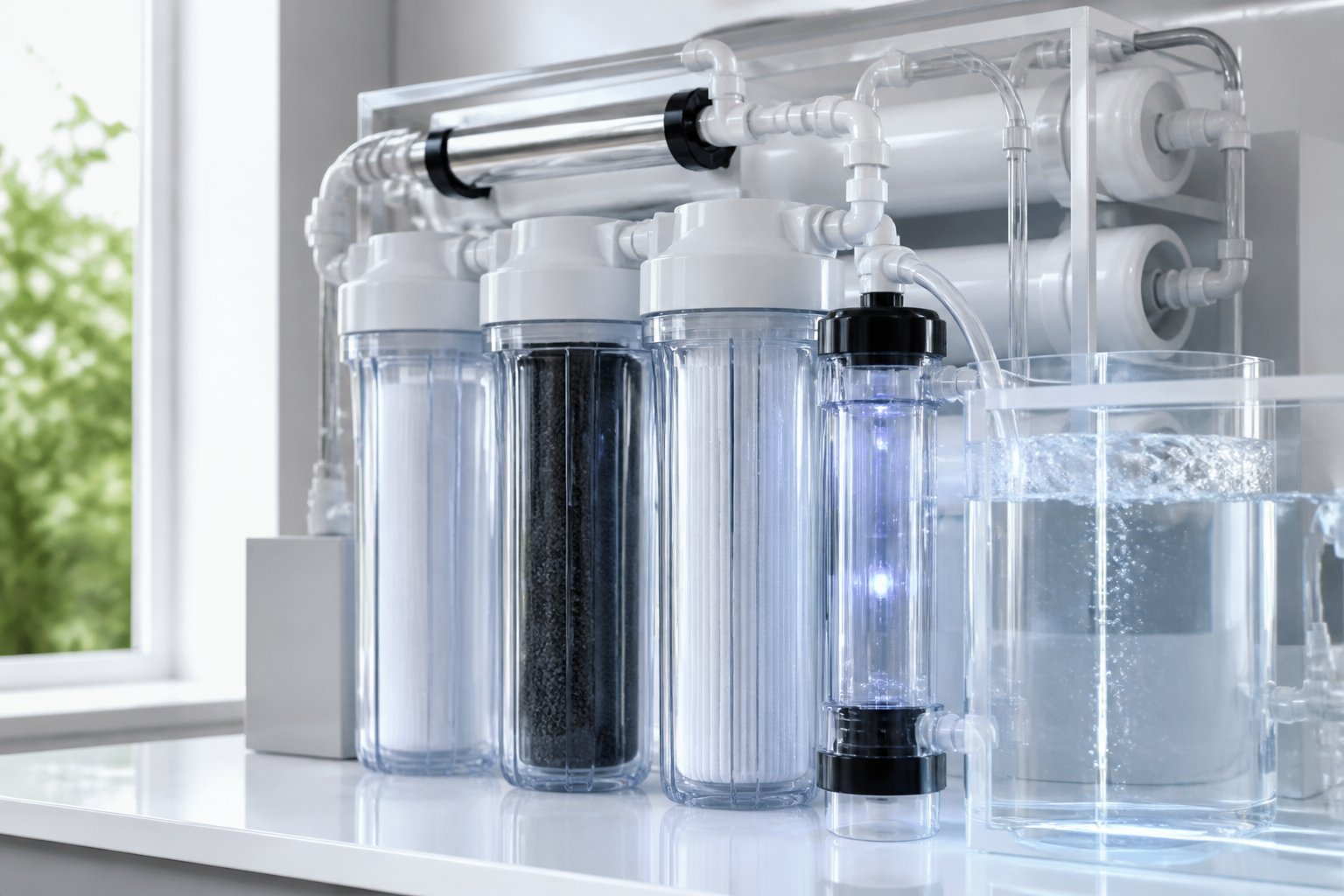
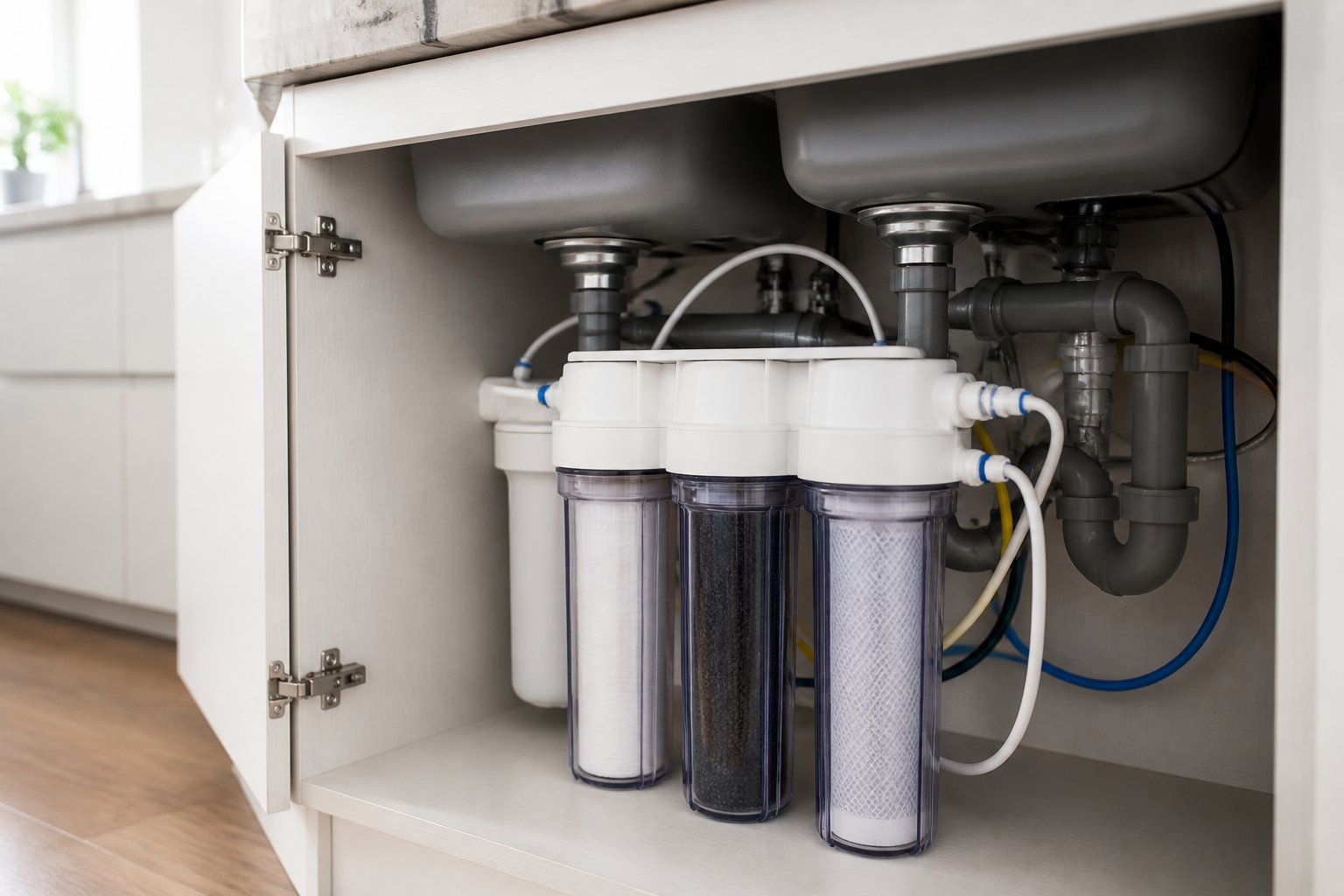
Core Filtration Technology and Contaminant Removal
Reverse osmosis systems use a pressure-driven membrane plus prefilters to remove dissolved and particulate contaminants. You get very low total dissolved solids (TDS) in the final water and longer membrane life when the prefilters stop particles and chlorine before they reach the RO membrane.
How Reverse Osmosis Works
Reverse osmosis forces water through a semi-permeable membrane under pressure. The membrane has very small pores that let water molecules pass but block most dissolved salts, organics, and many microbes. You measure RO performance by percent rejection and by drop in total dissolved solids (TDS) on a TDS meter.
A typical household RO stack operates at 40–90 psi feed pressure and produces two streams: low-TDS permeate (your drinking water) and a concentrated brine that carries rejected contaminants away. Membrane life depends on feed water quality and maintenance; fouling from iron, hard scale, or chlorine damage shortens it. For technical background on membrane science and applications, see this overview of how reverse osmosis works.
Key Contaminants Removed
RO membranes remove dissolved salts, heavy metals (lead, arsenic, cadmium), and many small organic molecules. You should expect removals often above 90% for inorganic ions and typical municipal contaminants. RO also reduces nitrate, fluoride, and sulfate to low levels.
RO is less effective for volatile organic compounds (VOCs) that pass through membranes without pre-treatment, and it does not add disinfectant. You may need post-treatment if you want mineral balance or taste adjustments. For emerging contaminants and pharmaceuticals, RO plus other processes often gives the best removal results; see studies on membrane effectiveness for more detail.
Role of Sediment and Carbon Prefilters
Sediment prefilters catch sand, rust, and silt to protect the RO membrane from physical clogging. You should replace sediment cartridges regularly based on turbidity and flow drop to avoid premature membrane fouling.
Carbon prefilters remove free chlorine and many organic chemicals that would damage the RO membrane or affect taste. Use a high-capacity activated carbon stage ahead of the membrane if your feed is chlorinated. Together, sediment and carbon prefilters extend membrane life, improve water quality, and reduce maintenance frequency.
System Types and Space-Saving Options
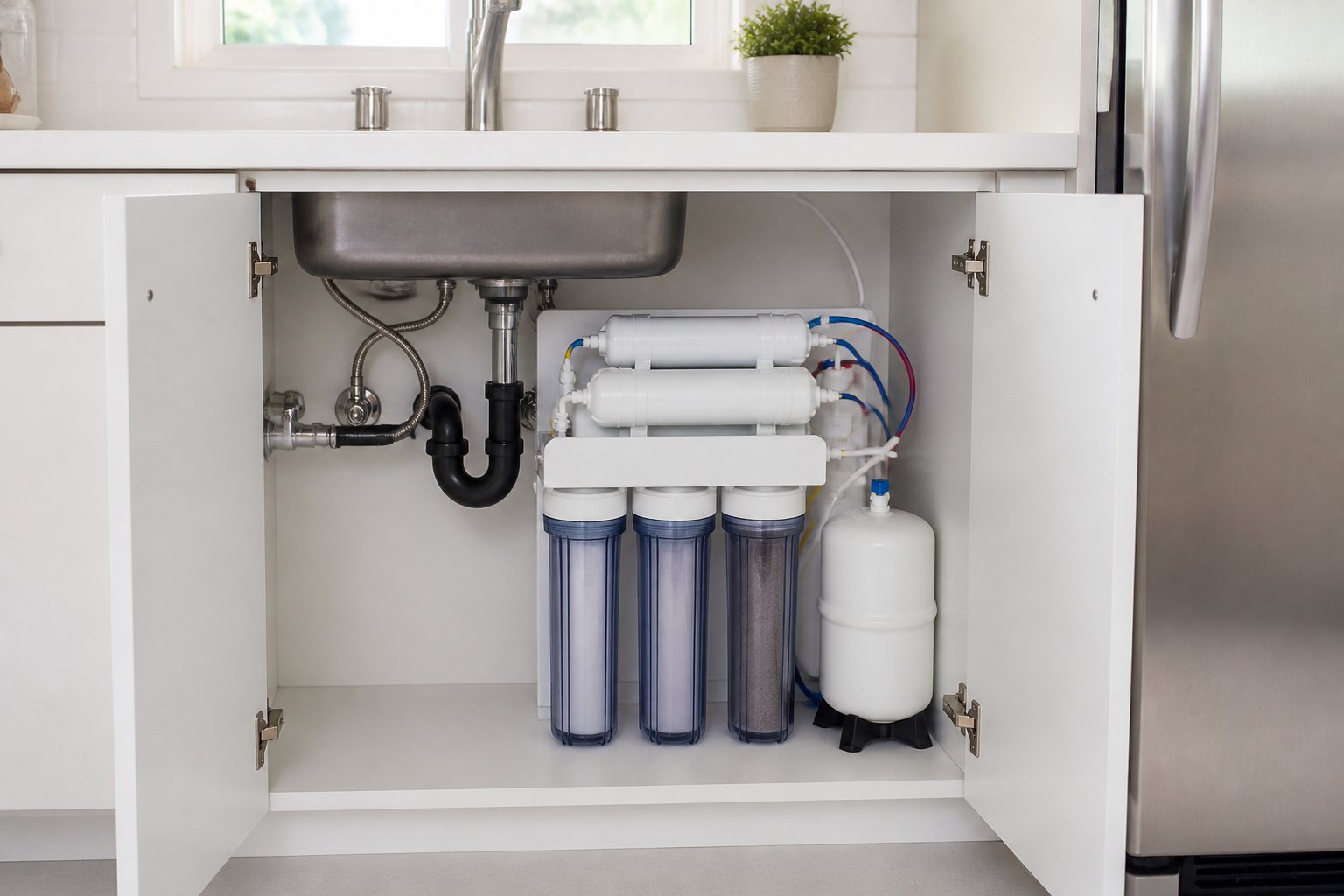
You need a filter that fits the space under your sink, gives the flow you want, and keeps maintenance simple. Choose between tanked systems that store treated water, tankless models that filter on demand, and compact units that sit on a counter or integrate with your fridge.
Under-Sink and Tankless Designs
Under-sink reverse osmosis systems install inside your cabinet and connect to a dedicated faucet. Traditional under-sink RO uses a storage tank to hold filtered water. That tank gives faster pour rates for filling pitchers or making ice, but it takes cabinet space and can limit room for other items.
Tankless under-sink RO filters, like some Waterdrop models, use an electric pump to deliver water on demand. Tankless units free up storage space and often waste less water per gallon filtered, but they need an outlet and can be noisier. If you want minimal plumbing changes and steady flow, pick a tanked under-sink RO. If you want compact storage and faster continuous flow, choose a tankless under-sink RO.
Space Constraints and Kitchen Integration
Measure your cabinet height, depth, and clearances before buying. A 9" diameter tank with 15" height fits many cabinets, but stacked pipes, garbage disposals, and water heaters reduce usable space. Note where you can drill for the drain saddle and whether you can add an outlet for a pump.
Think about fridge and ice-maker hookups. Some systems can feed a refrigerator dispenser directly; others need a small booster or tank to keep pressure steady. Also compare filter change access: front-twist cartridges save time, while bolt-on housings may need more reach. If you plan to hire a plumber, include the added cost for an outlet or cabinet modifications.
Cloud RO and Compact Pitchers
Cloud RO is a modern under-sink option that uses a small tank and a permeate pump to boost pressure and efficiency. Its compact dimensions and near-silent operation make it a good fit when space and noise matter. The system often includes app monitoring for TDS and filter life, which helps you schedule replacements.
Countertop and pitcher-style RO or remineralizing pitchers suit renters or tight kitchens. They need no permanent install and take little space, but they filter more slowly and may not remove as many contaminants as a full under-sink RO. If you like a balance of performance and small footprint, compare compact under-sink models such as the iSpring RCC7 and the Waterdrop G3/G3P600 family for size, flow rate, and certification before deciding.
Performance Metrics and Water Efficiency
You should watch how much purified water the system makes, how fast it makes it, and how much waste it sends down the drain. These three numbers tell you whether the filter meets your daily needs and how much water it will consume.
Flow Rate and Water Production Rate
Flow rate usually refers to how fast the system delivers water at the faucet. Manufacturers often list this as gallons per day (GPD) for the membrane and as gallons per minute (GPM) or liters per minute at the tap. Check the membrane's rated GPD — common values are 50, 75, 100, or 300 GPD. That rating assumes ideal feed water (low TDS) and a specific pressure and temperature.
Measure real output by collecting pure water for a set time and dividing volume by time. Low feed pressure, cold feed water, or high TDS will reduce the membrane’s actual water production rate. If you need more daily water, choose a higher GPD membrane or add a booster pump to raise feed pressure.
Wastewater Ratio and Pure-To-Drain
The wastewater ratio (pure-to-drain) tells you how much clean water you get for each gallon sent to drain. Typical home RO units range from 1:1 to 1:4 (pure). That means at 1:4 you get 1 gallon of purified water for every 4 gallons wasted. Newer systems and WaterSense-guided designs can hit better ratios under lab conditions.
You can improve the pure-to-drain by lowering recovery (less stressed membrane), adding permeate pumps, or using systems with a storage tank sized for your usage pattern. Measure it yourself: collect permeate and concentrate separately over the same time interval and divide volumes to get the actual ratio for your water conditions.
High Flow Rate Options
High flow rate systems increase tap flow or daily production. Options include membranes rated 300+ GPD, multi-membrane arrays, or point-of-entry plus point-of-use hybrids. You can also choose systems with a larger pressurized storage tank or an inline booster pump to deliver stronger faucet flow on demand.
Note trade-offs: higher GPD membranes may need higher feed pressure and better pre-treatment to avoid fouling. Pumps raise energy use and add complexity. If you want quicker faucet flow without changing membrane, a permeate pump or larger tank often delivers the best balance of speed and water efficiency. For performance specs and efficiency guidance, review EPA WaterSense documents on RO performance (point-of-use) to compare rated and tested values.
Installation and Maintenance
You will need basic plumbing tools, clear workspace under the sink, and a schedule for filter changes and sanitizing. Expect simple tubing connections, a dedicated faucet hole, and occasional checks for leaks and tank pressure.
Easy DIY Install and Plumbing Requirements
Most under-sink RO systems install with simple tools: an adjustable wrench, Phillips screwdriver, drill for a faucet hole, and Teflon tape. You mount the RO unit on the cabinet wall, connect the cold-water feed with the included feed adapter, and attach color-coded tubing to the faucet, tank, and drain saddle.
Drill the drain saddle above the P-trap and avoid placing it below the P-trap to prevent odors. Leave a few inches of slack in tubing so you can remove the unit for service. Turn off the cold-water valve and relieve pressure before cutting any lines.
Check for leaks slowly by opening the cold-water valve partway first. Tighten fittings to stop drips but avoid overtightening plastic parts. If your plumbing uses unusual fittings or you install a whole-house RO, hire a plumber.
Filter Replacement Procedures
Replace pre-filters (sediment and carbon) every 6–12 months depending on water quality. These protect the RO membrane; neglected pre-filters often cause slow flow and poor rejection. Change the post-filter (taste/charcoal) every 6–12 months as well to keep water flavor neutral.
The RO membrane usually lasts 2–3 years. Expect shorter life with hard or contaminated source water. To replace, close the feed valve, drain the storage tank, and depressurize by opening the RO faucet. Swap cartridges per the manufacturer’s diagram and flush the system after reassembly for several tankfuls.
Sanitize the system yearly when you change major filters. Use a manufacturer-approved sanitizer and follow the manual steps to avoid contaminating the membrane. Keep a log with dates for each filter change and tank pressure checks.
Replacement Filter Availability
Replacement filters come from OEMs and third-party manufacturers. Look for filters that match your model number or use cross-reference guides found on many vendor pages. Buying genuine cartridges ensures fit and rated performance; compatible filters often cost less but check pore size and media type.
You can order filters online from manufacturer stores, specialty retailers, or local plumbing suppliers. Keep one set of pre-filters and a post-filter on hand so you don’t miss scheduled changes. For membranes, plan ahead — they are less common in local stores and may need online ordering with 3–7 day delivery.
For model-specific guidance, consult your system manual or the installation and maintenance guides provided by major RO suppliers.
Remineralization and Water Taste
Remineralization helps water taste fuller, restores calcium and magnesium, and can raise pH and buffering so your water stays stable after pouring.
Importance of Alkaline Remineralization
Alkaline remineralization adds minerals that increase alkalinity and raise pH slightly. You get better buffering, so water does not pick up carbon dioxide and turn acidic after sitting in a glass. That matters if you test pH or brew coffee; stable pH helps extraction and flavor consistency.
The common media are calcite (calcium carbonate) and magnesium oxide blends. Calcite gently raises hardness and pH. Magnesium blends add a bit more flavor and mouthfeel. Expect modest changes: typical inline cartridges add about 20–40 ppm TDS and move pH toward neutral or mildly alkaline.
If your tap water is very low in minerals, adding too much can cause scale in kettles. Match the media to your use: choose calcite for general drinking, a magnesium blend for coffee, or liquid drops for precise control.
Mineral Add-Back Practices
You can add minerals in several ways: inline cartridges, liquid mineral drops, or by blending with mineral water. Each method gives a different control level and effort.
- Inline cartridge: set-and-forget. It raises TDS gradually every time you dispense water.
- Mineral drops: high control. You dose per bottle or cup. Use when you want exact TDS for brewing.
- Blending: mix RO with a measured share of tap or bottled mineral water. Do math with TDS to reach your target.
Test with a TDS meter and a pH strip. Aim for drinking water around 30–150 ppm TDS depending on taste. Replace media or re-dose drops when TDS or taste falls back.
Post-Filtration Systems
Most post-RO units install after the membrane and sometimes after the storage tank. Proper placement ensures water contacts the media and you get consistent mineral pickup.
Options include single-stage calcite cartridges, multi-media alkaline stages, and compact remineralization cartridges designed for under-sink RO systems. Lifespan varies: many cartridges last 6–12 months, but heavy use shortens life. Check flow direction and change intervals printed on the filter.
For precise needs—like espresso—combine a post-filter with periodic lab testing or a TDS/pH check. If you pick a branded inline stage, review manufacturer specs for expected TDS lift and pH change before buying. For example, clinical guides and product pages explain typical TDS increases and maintenance steps in plain terms (see practical guides and product recommendations).
Conclusion
Reverse osmosis delivers some of the cleanest drinking water available, but performance depends on the whole system: prefilters that protect the membrane, the right flow rate and waste ratio for your household, and remineralization if you want better taste. Match these pieces to your space, water quality, and daily usage, and stick to a replacement schedule to keep rejection rates high.
Ready to upgrade your water quality? Check out our comprehensive services at Irvine Water Filtration to explore RO systems built for your home.