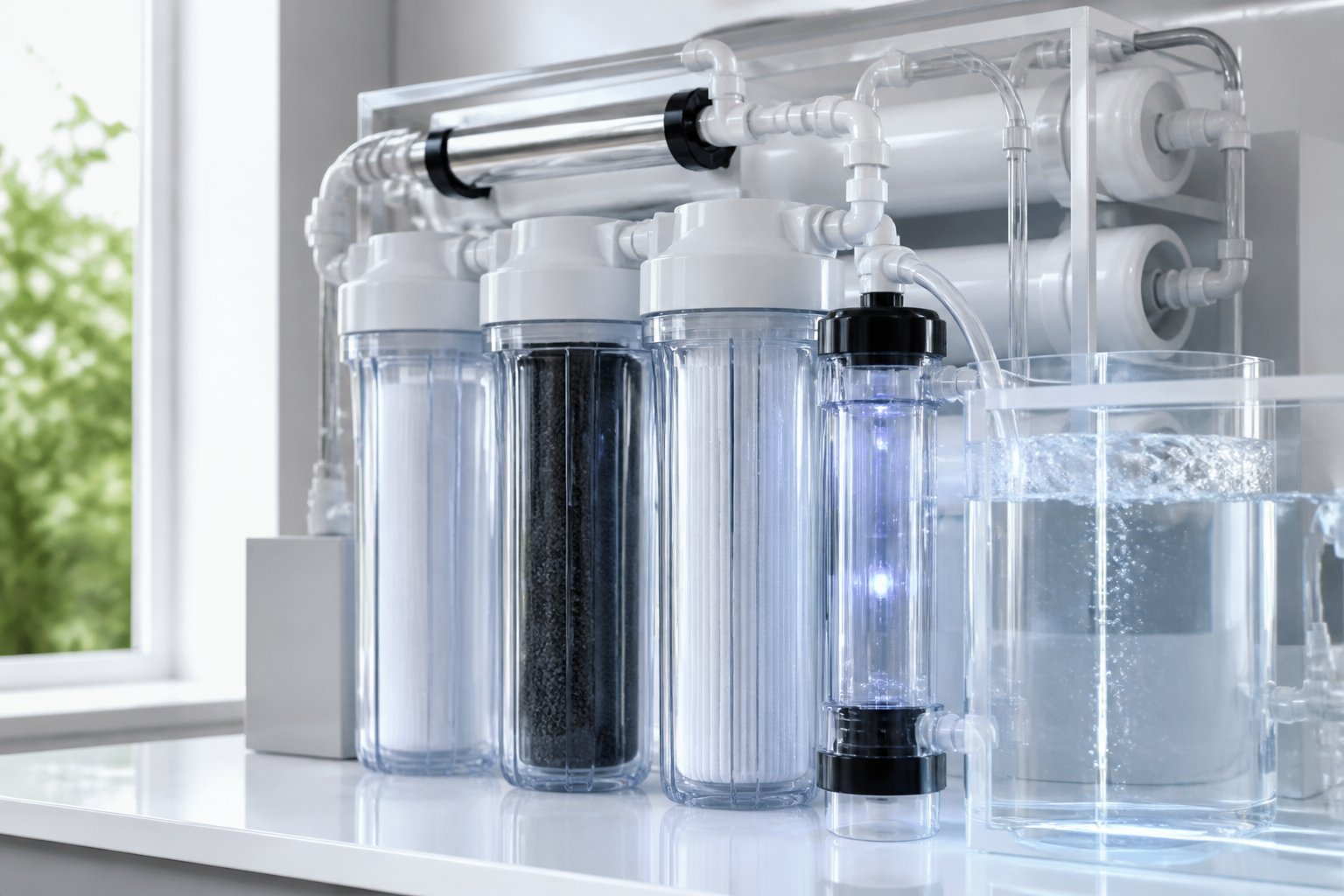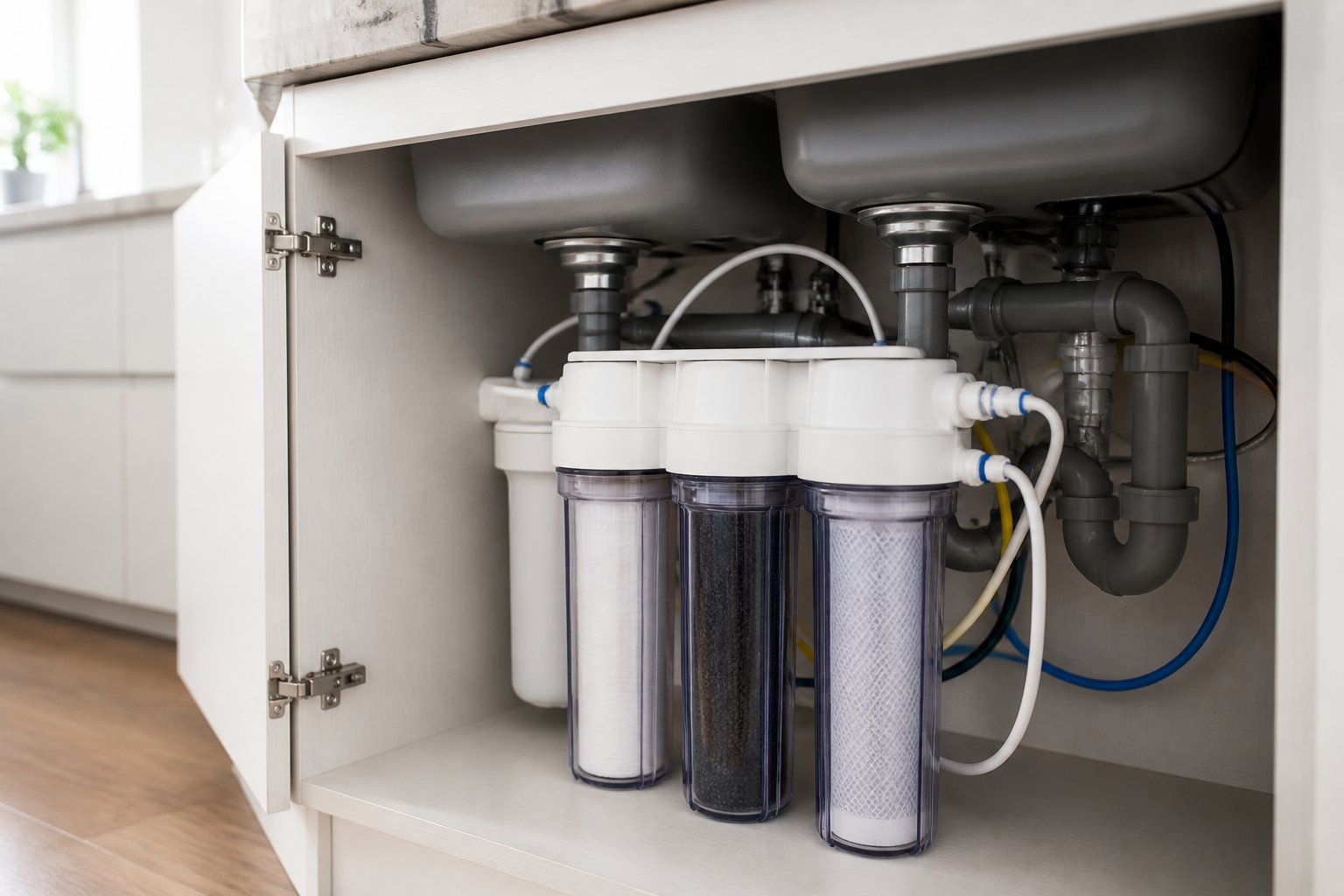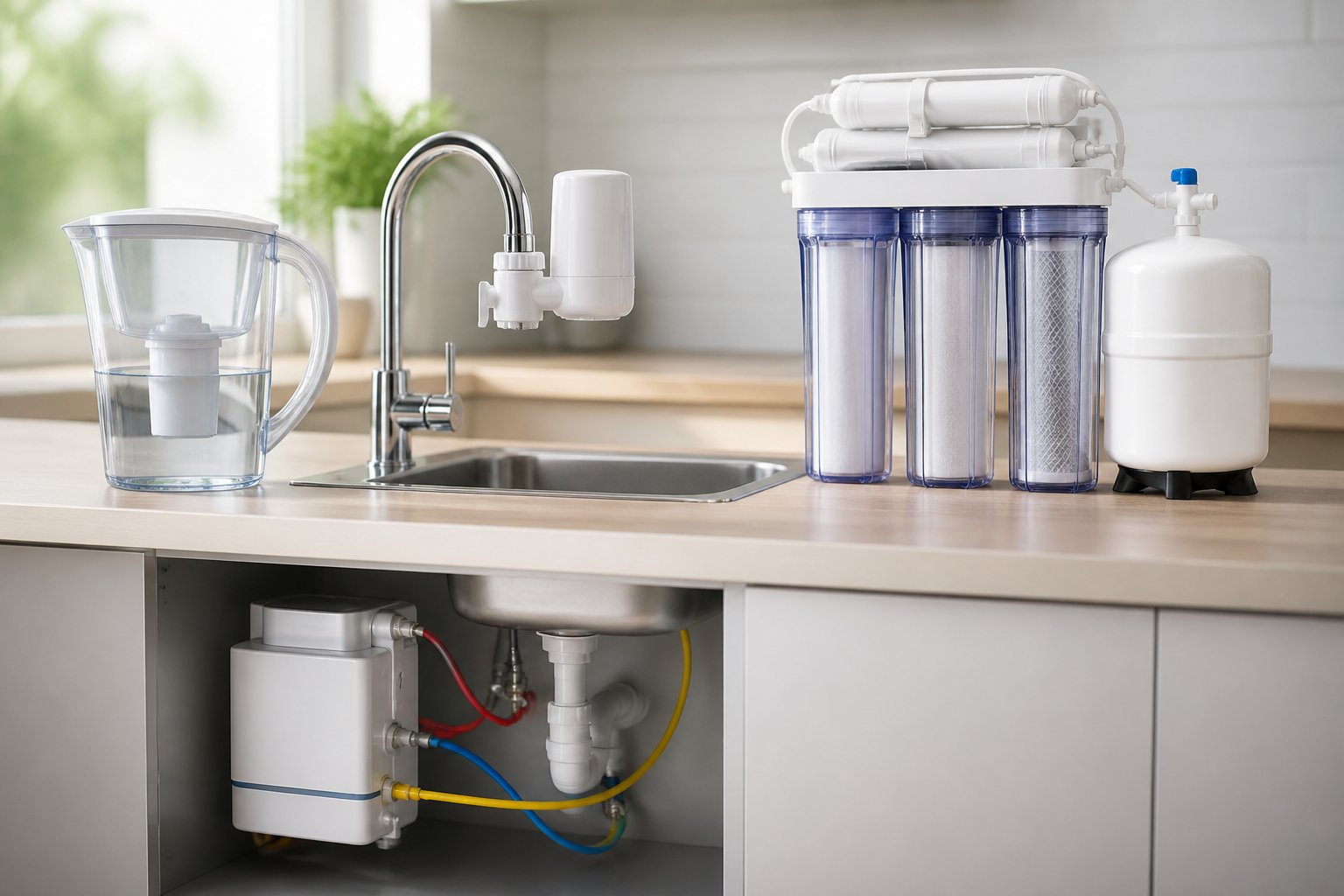
Types of Home Water Filtration Systems
You need the right filter for the places you use water most: the whole house, under a sink, on a counter or faucet, or inside a pitcher or refrigerator. Each option removes different contaminants, costs different amounts, and needs different maintenance.
Whole House Water Filters
A whole house water filter treats water at your main shutoff so every tap, shower, and appliance gets filtered water. These systems often use multi-stage media: sediment pre-filters, activated carbon for chlorine and VOCs, and specialty media or softeners for iron or hardness. Installation usually ties into your plumbing and can cost from about $1,000 to $3,000 depending on media and size.
You should pick a system after testing your water so the filter targets specific contaminants. Expect cartridge or media changes every 3–12 months for sediment and carbon, and resin/medias less often. See a comparison of common system types and costs in this guide to home water filtration systems.
Under-Sink and Point-of-Use Filters
Under-sink filters sit beneath a single faucet and give you filtered drinking and cooking water without treating the whole house. Systems range from single carbon cartridges to multi-stage units with reverse osmosis (RO) and a storage tank. Cartridge-based under-sink systems cost roughly $150–$500, while under-sink RO systems run $500–$1,000 up front.
You get higher contaminant removal at the point of use. RO removes dissolved salts, fluoride, and some metals; carbon removes chlorine, taste, and many organic chemicals. Replace cartridges and RO membranes per manufacturer schedules—typically every 6–24 months—to keep flow and performance steady.
Countertop and Faucet-Mounted Filters
Countertop and faucet-mounted filters attach without major plumbing changes and are fast to install. Countertop units include gravity housings, countertop RO, and carbon dispensers. Faucet-mounted filters screw onto the faucet spout and use granular or carbon block cartridges to cut chlorine, bad taste, and some particulates.
These options cost less—countertop units often $80–$500 and faucet-mounted filters $30–$100. They work well if you rent or want a no-plumbing solution. Maintenance is simple: swap cartridges every 2–12 months depending on usage. For a broader rundown of countertop and faucet options, consult this guide to types of home water filtration systems.
Water Filter Pitchers and Refrigerator Filters
Pitcher filters and refrigerator water filters offer low-cost, user-friendly ways to improve drinking water quality. Pitcher filters use a carbon-based cartridge inside a jug to reduce chlorine, lead (in some models), and improve taste. They cost $40–$150 and need cartridge changes every 1–3 months.
Refrigerator filters are either built into the fridge or installed inline on the water line. They primarily remove chlorine, taste, and some particulates so ice and dispensed water taste better. Expect replacement every 6–12 months. These point-of-use choices suit small households, renters, or as a backup to larger systems; they are easy to use and require minimal installation.
Key Technologies and Filtration Methods
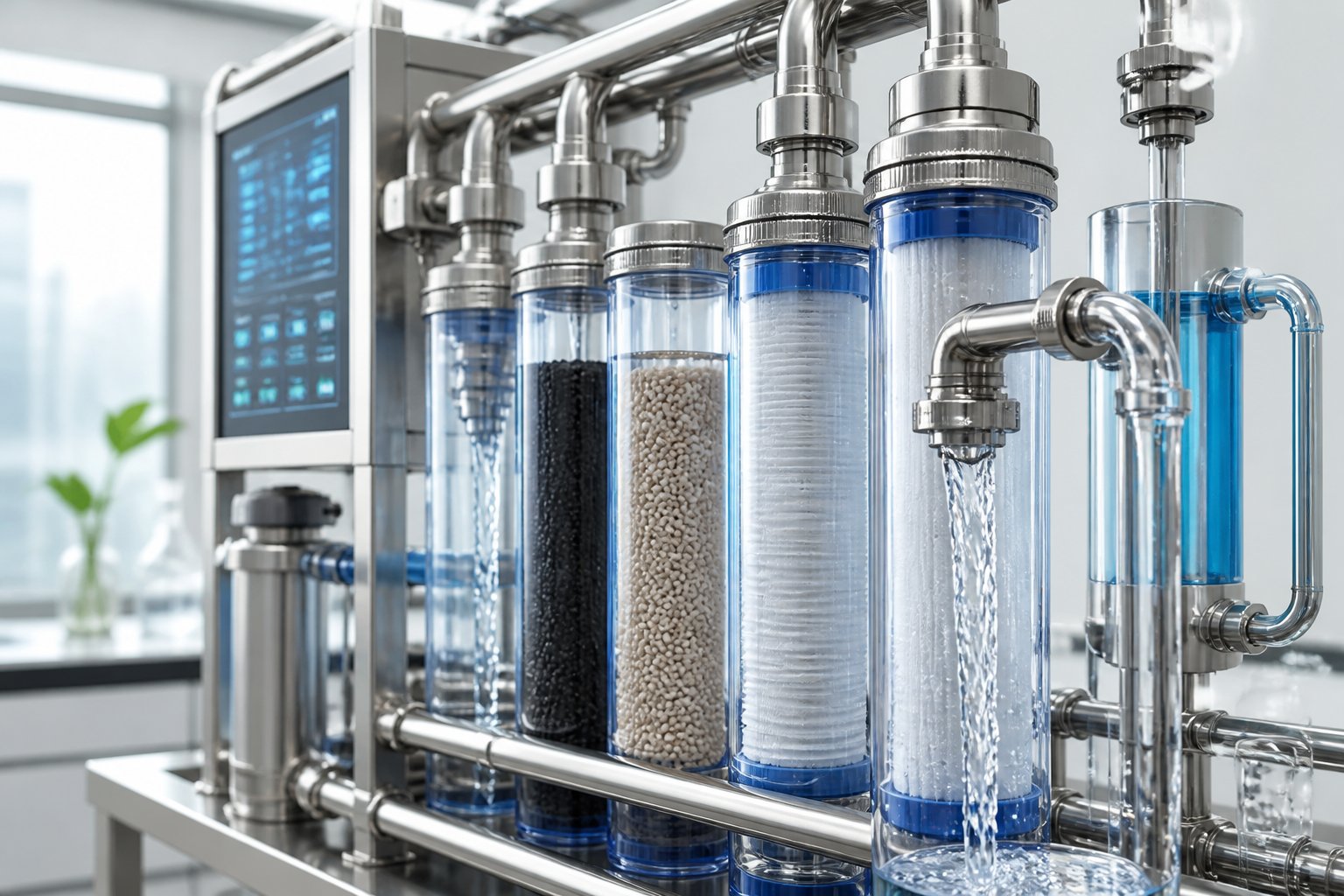
These methods remove particles, chemicals, and hardness using different physical and chemical actions. Each method targets specific contaminants, and you can combine them to meet your water quality needs.
Activated Carbon and Carbon Block Filters
Activated carbon adsorbs organic chemicals and chlorine that affect taste and odor. You’ll find loose granular activated carbon (GAC) in pitchers and whole-house units, and denser carbon block cartridges in under-sink or point-of-use systems. Carbon block filters have fine pores that trap small particles and provide longer contact time for adsorption, so they remove more volatile organic compounds (VOCs) and chlorine byproducts than simple GAC.
Replace carbon cartridges on the schedule the manufacturer recommends. Saturated carbon stops removing contaminants and can release them back into your water. Look for NSF/ANSI certifications when you need verified reduction of specific contaminants.
Reverse Osmosis and Semipermeable Membranes
Reverse osmosis (RO) forces water through a semipermeable membrane to remove dissolved salts, nitrates, fluoride, and many small organic molecules. You’ll usually see RO systems as under-sink units with a pre-filter and a post-carbon filter to protect the membrane and polish the water for taste.
RO systems waste some water as brine during rejection; typical household units reject 2–4 gallons for every gallon purified unless they use recovery pumps or efficient membrane designs. Keep pre-filters in good condition to prevent membrane fouling and replace the RO membrane per the manufacturer’s schedule for steady performance.
Ion Exchange and Water Softeners
Ion exchange swaps hard calcium and magnesium ions for sodium or potassium to soften water. Your water softener contains resin beads that carry sodium; as hard water passes, the beads capture hardness ions and release sodium. Regeneration flushes the resin with brine to restore capacity.
You’ll need space for a brine tank and periodic salt refills. Ion-exchange softening does not remove bacteria or most organic contaminants, so pair it with filtration or disinfection if those are concerns. Consider metered (demand) regeneration to save salt and water compared to timer-based systems.
Sediment and Pre-Filters
Sediment filters remove sand, rust, silt, and large particles to protect downstream equipment and improve clarity. You can use spun polypropylene cartridges, pleated filters, or washable mesh screens depending on your flow and dirt load. Install a sediment pre-filter before carbon, RO membranes, or softeners to reduce clogging and extend service life.
Backwashing filters use reverse flow to flush trapped solids and are common in whole-house systems with high particulate loads. Monitor pressure drop across sediment filters; a rising pressure drop signals clogging and the need for cleaning or replacement.
Water Contaminants and Filtration Effectiveness
You need to know which contaminants are likely in your water and which filters remove them. Some filters target chemicals and metals, others stop germs, and a few reduce minerals that cause hard water.
Common Chemicals and Heavy Metals
Chlorine, lead, iron, mercury, and arsenic are common worries in tap or well water. Activated carbon filters cut chlorine taste and odor very well. Reverse osmosis (RO) and certain certified filters remove lead, mercury, and arsenic to low levels when they have the proper rating.
Check product certifications like NSF listings to confirm claims. Whole-home carbon systems can lower volatile organic compounds (VOCs), herbicides, and pesticides before the water reaches taps. Iron may need a filter designed for particulate or an oxidizing prefilter, since simple carbon cartridges can foul. Filter life and proper replacement affect how well heavy metals and chemicals stay out of your glass.
PFAS, PFOA, and Other Emerging Contaminants
PFAS (including PFOA and PFOS) resist breakdown and can appear in drinking water near industrial or firefighting sites. Not all filters remove PFAS. Granular activated carbon (GAC) and RO systems can reduce many PFAS, but performance varies by compound and system design.
Look for lab test data or NSF/ANSI certifications relevant to PFAS removal. Whole-home systems rarely address PFAS across all taps unless they include RO or specially tested carbon stages. You may need a certified point-of-use filter at the kitchen tap for the best PFAS reduction.
Microorganisms: Bacteria and Viruses
Most pitcher and fridge carbon filters do not remove germs. To protect against bacteria (E. coli, Salmonella) and larger parasites (Giardia, Cryptosporidium), choose filters with absolute pore sizes small enough—typically 0.3–1 micron for bacteria and 1 micron or smaller for cysts. Ultrafiltration, nanofiltration, and RO remove many microbes.
Viruses are much smaller and require nanofiltration, RO, or disinfection (UV, chlorination) to reduce risk. If you rely on a private well or have immune-compromised household members, test the water and use systems rated for microbial removal. Follow manufacturer guidance for maintenance to avoid contamination during filter changes.
Hard Water and Mineral Removal
Hard water contains calcium and magnesium and may include dissolved iron. Water softeners (ion exchange) swap sodium or potassium for calcium and magnesium, reducing scale on pipes and appliances. RO systems also reduce hardness by removing dissolved minerals, though they waste more water.
Softening does not remove chemicals like VOCs, chlorine, or PFAS. If your water has both hardness and chemical contaminants, you may need a combined setup: a softener or pre-treatment and a point-of-use RO or carbon filter for drinking water. Test hardness in grains per gallon (gpg) or mg/L to size the right system.
Performance, Certifications, and Maintenance
You should expect clear proof that a filter removes the contaminants you care about, that it fits your water pressure and flow needs, and that replacement parts and costs match your budget. Look for tested reduction claims, a stated micron rating, and a replacement schedule before you buy.
NSF and WQA Certifications
Check for an NSF/ANSI certification number on the product label. NSF tests filters against standards like NSF/ANSI 42 (taste and odor) and NSF/ANSI 53 (health-related contaminants). A certified filter will list the exact contaminants it reduces and the test protocol used.
WQA Gold Seal also indicates independent testing and manufacturing audits. You can verify certification listings on the certifier’s database to confirm the model and performance claims. If you want higher confidence for municipal or private well water, compare claims to your local Consumer Confidence Report or lab test results.
If a product only lists general claims without a certification reference, treat those claims cautiously. Certified units usually include clearer installation instructions and capacity labels that explain when to replace cartridges.
Flow Rate, Water Pressure, and Micron Ratings
Match the filter’s rated GPM (gallons per minute) to your fixture. Under-sink and whole-house filters often state a flow rate like 0.5–2.5 GPM; shower or house systems need higher flow. Low-flow filters can cause reduced pressure unless your system includes a booster or larger piping.
Check the operating water pressure range (psi). Most point-of-use filters work between 20–80 psi. Exceeding the max can damage housings or reduce filter life.
Look at micron ratings to know what the filter removes physically. Typical values: 5–10 microns for sediment, 0.5–1 micron for fine particulates, and 0.0001 micron (RO membranes) for dissolved solids. A smaller micron number means finer filtration but also lower flow and faster clogging. Balance micron rating with flow rate and your water test results.
Filter Lifespan and Capacity
Filter lifespan usually appears as either time (months) or volume (gallons). Common labels: “6 months or 1,000 gallons.” Use whichever limit you hit first. Your actual lifespan will vary with incoming water quality and household water use.
Manufacturers base capacity on standardized test water. If your water has high sediment, chlorine, or iron, expect earlier replacement. Keep a simple log of installation dates and meter reading or count weeks to track life.
Whole-house filters and softeners often list larger capacities (thousands of gallons) and need scheduled service. Reverse osmosis membranes last 2–5 years; prefilters typically change yearly. Follow the installation guide for flushing and initial run times to avoid premature fouling.
Replacement Filters and Maintenance Costs
Compare replacement cartridge costs before you buy. A low upfront price can hide high recurring expenses. Note replacement cartridge cost, how often you must replace it, and whether specialty parts like RO membranes or UV lamps are needed.
Estimate annual maintenance cost: multiply cartridge cost by annual replacement frequency, then add any service fees. Expect $20–$200 per year for basic point-of-use systems; whole-house or RO setups can run higher.
Plan for simple maintenance tasks you can do yourself—filter swaps, O-ring lubrication, and system flushing—to save on technician fees. Keep a spare cartridge on hand if delivery time is long. Check manufacturers’ instructions for proper filter installation to keep warranties valid and ensure certified performance.
Installation Options and Choosing the Right System
You need to match system type to water quality, space, and budget. Think about where you want filtered water (whole house, under-sink, or shower), how often you’ll change filters, and whether you want a pro to do the work.
DIY vs. Professional Installation
If you are comfortable with basic plumbing, a straightforward under-sink carbon filter or a countertop unit often fits a DIY project. You will shut off the cold-water valve, add a tee or adapter, mount the unit, and run tubing. Typical DIY installs take 1–3 hours and need tools like a pipe cutter, wrench, and PTFE tape.
Hire a pro when work involves the main water line, a whole-house unit, or electrical/UV hookups. Pros handle permits, pressure issues, and bypass loops. For well water, you may need a licensed plumber to add a UV or pressure tank. If you live where codes require air-gap faucets for RO systems, a pro can ensure compliance and reduce leak risk.
Installation Costs and Considerations
Expect different price ranges by system type. Under-sink carbon units often cost $50–$300 for parts. Basic RO kits run $150–$600. Whole-house sediment + carbon systems typically cost $300–$1,200 or more for equipment. Professional labor can add $150–$800 depending on complexity and region.
Also budget for fittings, shut-off valves, mounting brackets, and any permits. Add-ons like UV sterilizers, water softeners, or extra prefilters raise both parts and labor. Consider long-term costs: cartridge replacements (every 3–12 months), RO membrane changes, and periodic water testing. Track initial cost plus annual maintenance when comparing options.
Selecting a System for Municipal or Well Water
Test your water before buying. For municipal water with chlorine taste or odor, an activated carbon under-sink or whole-house carbon unit works well. For high dissolved solids, salts, or concerns about PFAS, consider an RO under-sink for drinking water. Use your city’s water quality report and a home or lab test to confirm targets.
If you use a private well, plan for sediment prefilters plus UV disinfection if bacteria are possible. Well systems often need multi-stage filtration: sediment → carbon → UV or RO. Whole-house sediment filters protect appliances and a point-of-use RO or carbon can handle drinking water. For well-specific guidance, consider brands that specialize in well solutions and ask a pro to test for bacteria and iron.
Recommended Brands and Product Selection
Choose brands with clear performance specs and certifications (NSF/ANSI). Match product to your test results and space. If you need lab-grade removal of dissolved solids, pick an NSF 58-rated RO. For chlorine and taste, select NSF 42 or 53-rated carbon cartridges. Read replacement schedules, confirm compatible housings, and check that service parts are available. If you’re unsure, get a professional water test or consult a local installer who can recommend models that match your water profile.